Press Release · Survival Sip
Survival Sip Reviews: Packing Light and Planning Ahead? Inside the Brand's Pocket-Sized, Battery-Free Water Filter Straw
Distributed by Town Press · Originally issued via Newswire
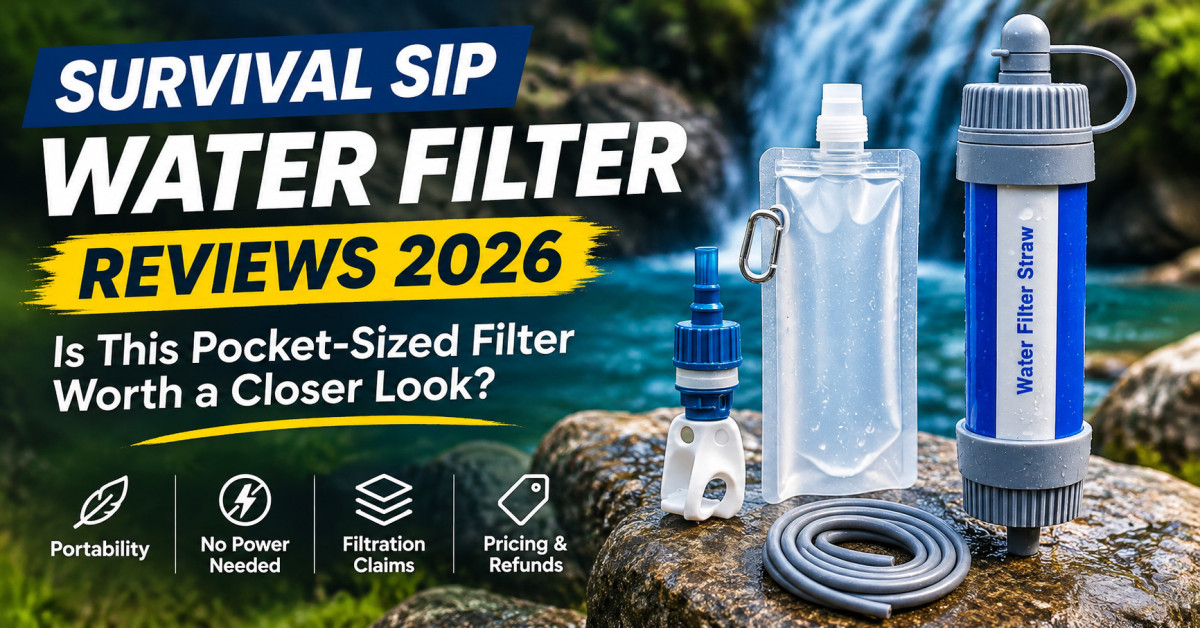
FOUNTAIN VALLEY, Calif., November 20, 2026 (Newswire.com) - Quick heads-up before we dig in: this is a paid advertorial with affiliate links, so a commission is earned if you buy through them, at no extra cost to you. That said, nothing here is sugar-coated. Every performance claim below is the brand's own, not something independently verified, and Survival Sip is a consumer water filter, not a medical device - the materials reviewed turned up no government approval or third-party safety certification. The brand's own site is unbindgear.com, and everything here reflects what was public in November 2026, so double-check the current details before you order.
Quick Answer: Survival Sip is a real, pocket-sized hollow-fiber water filter sold by Unbindgear, marketed for emergencies and the outdoors. The appeal is genuine: about two ounces, no power, no batteries. The catch is that the sales page lists three different filter lifespans and several different removal percentages, and the independent testing it advertises could not be located. It may still earn a spot in a kit if you treat it as a freshwater backup, not a cure-all, and read the return terms first.
You saw an ad for Survival Sip. Maybe it was on Facebook, maybe Instagram, maybe a short video that ended with a countdown and a discount code. Something about it stuck, and now you're doing the smart thing: checking the details before you spend money. Good call. Most of the "reviews" filling your search results are near-identical pages that copy the brand's bullet points and push a buy button. This one does the opposite. It lays out what the company actually claims, shows you where those claims disagree with each other, and tells you what to verify before checkout.
See Survival Sip's current Black Friday offer and its listed terms
Quick Verification Snapshot (As of November 2026)
Before the deeper review, here is what held up against the brand's own website and public sources at the time of writing, and what did not.
- The biggest unresolved issue (verified discrepancy): The brand's own product page advertises three different filter lifespans - up to 1,800 gallons in the hero section, 1,300 gallons in the comparison chart, and up to 100,000 gallons in the FAQ. Those numbers are not interchangeable, and nothing on the page explains the gap.
- Seller (verified): Survival Sip is sold by Unbindgear. Support lists a Fountain Valley, California business address and a separate San Leandro return address.
- Design and kit (brand-stated): Roughly 2 ounces, a 0.1-micron hollow-fiber membrane, and a kit with a filter straw, squeeze pouch, cleaning syringe, and carabiner.
- Pricing (brand-displayed): Source materials list single units around $39.99, scaling down to about $31.99 each on the five-pack. The live page currently shows a Black Friday promotion with code BF26 instead of fixed dollar figures.
- Returns (brand-stated, with conditions): A "90-day money-back guarantee" headline sits alongside return terms that can require a return authorization, original packaging, a possible 10% restocking fee, and a separate 14-day hygiene clause.
- What could not be verified independently: The advertised "independently tested three times" claim (no lab, protocol, or report was located), the "military-grade" comparison, the 4.7/5 rating from 21,191+ customers, and any evidence that the filter makes an unknown emergency source safe to drink.
Survival Sip Emergency Water Filter Straw Consumer Research: What's Verified and What's Unclear
Here's the honest version of a Survival Sip review. The product is easy to like on paper. A filter small enough to disappear into a glove box or a go-bag, with nothing to charge and nothing to plug in, is exactly the kind of thing most households never get around to buying until the tap stops working. The idea sells itself.
But a filter is one of those purchases where the marketing and the actual performance can live in two different rooms. Portability is easy to prove - you can feel it in your hand. Filtration is not. It depends on the membrane, the water you put through it, how it's maintained, and whether anyone credible has measured what comes out the other side. So the useful question isn't "does this look convenient?" It obviously does. The question is "which of these claims can I actually confirm, and what happens to my money if the product disappoints?" That's what the rest of this covers.
A quick note on tone: nothing here calls Survival Sip a scam, and nothing here calls it a bargain. Both of those verdicts would be guesses. What follows is a plain reading of the brand's own pages and the public health guidance that applies to any portable filter, so you can decide whether it fits your situation.
What Is Survival Sip, and Who Actually Sells It?
According to the company, Survival Sip is a compact personal water filter you can carry without electricity, batteries, or a bulky setup. The brand states it weighs about two ounces and ships with a filter straw, a squeeze pouch, a cleaning syringe for backflushing, and a carabiner clip. The brand describes several ways to use it: sipping straight from a water source, drinking through the squeeze pouch, screwing the filter onto a standard bottle, or connecting it to some hydration-pack setups.
The seller is Unbindgear. That matters more than it sounds, because "Survival Sip" is a product name, not a company, and there are several similarly named and similar-looking straw filters floating around online from unrelated sellers. If you're comparing reviews, make sure the one you're reading is about the Unbindgear product and not a look-alike. One more detail worth noticing: the brand's published business address (Fountain Valley, California) is different from its published return address (San Leandro, California). That's not automatically a problem - plenty of companies use a separate returns facility - but it's the kind of thing you want to confirm before you ship anything back.
Buyer takeaway: Survival Sip is a genuine product from a real seller, Unbindgear, with reachable contact details. Confirm you're buying the Unbindgear version rather than a similarly named straw, and note that the company address and the return address are not the same location.
Survival Sip vs. LifeStraw Sip: They Are Not the Same Product
This one trips people up constantly, so it's worth a dedicated moment. Survival Sip (from Unbindgear) and the LifeStraw Sip (from LifeStraw) are different products from different companies, and searching for one while meaning the other is an easy way to buy the wrong thing. They aren't really competitors you're cross-shopping - they're two items that happen to share a word.
A couple of distinctions actually matter. LifeStraw is a long-established filter brand, and it describes its Sip as a reusable stainless-steel 0.2-micron membrane microfilter for bacteria, parasites, and microplastics, backed by its own published performance data sheet. Survival Sip advertises a 0.1-micron hollow-fiber membrane, but as covered below, its own page can't agree with itself on capacity, and no comparable independent performance sheet turned up. So the honest contrast isn't "which one filters better" - it's that one brand documents its product more consistently than the other. Both share the same hard limit, though: per each brand's materials, neither is designed to remove viruses, salt, or dissolved chemicals.
Buyer takeaway: If you searched "Survival Sip" but the review in front of you is describing a stainless-steel LifeStraw, you're reading about a different product. Match the exact brand and model - Unbindgear's Survival Sip versus LifeStraw's Sip - before you compare specs or pay.
See Survival Sip's listed specifications and what ships in the box
How Does Survival Sip Claim to Work?
Per the official website, Survival Sip relies on a 0.1-micron hollow-fiber membrane. The idea behind that technology is straightforward: water gets pushed through microscopic pores that are small enough to physically block bacteria and protozoa while letting water molecules pass. Because it's mechanical, there's no waiting for a chemical to work and nothing to power. The brand states the filter is designed to address bacteria such as E. coli, protozoan parasites such as Giardia and Cryptosporidium, microplastics, and sediment.
That's a reasonable description of how hollow-fiber filters generally work, and the 0.1-micron pore size is in the same range as several established microfilters. What the available materials don't do is substantiate the specific removal percentages for this finished product, confirm the test conditions behind them, or show certification to a recognized filtration standard. In other words, the mechanism is plausible; the exact numbers are the brand's to prove.
Quick answer: Survival Sip water filter reviews often repeat a 0.1-micron hollow-fiber design that targets bacteria, protozoa, and microplastics. The approach is standard for microfilters, but the brand's specific removal percentages and test conditions were not independently confirmed in the materials reviewed for this article.
What Survival Sip Will Not Remove - Read This Before an Emergency
This is the part the countdown-timer pages skip, and it's the most important paragraph here. An ordinary 0.1-micron microfilter is built for biological threats in freshwater. It is not a universal fix. Guidance from the U.S. Centers for Disease Control and Prevention and the U.S. Environmental Protection Agency is consistent on the limits of portable filtration, and those limits apply to any straw-style filter, Survival Sip included.
- Viruses: Viruses are generally smaller than a 0.1-micron pore, so ordinary microfilters are not considered reliable virus protection. Where viral contamination is a concern, public health guidance points to a purifier or an added disinfection step.
- Dissolved chemicals, heavy metals, and salt: A mechanical membrane does not remove salt, lead, fuel, pesticides, or most dissolved chemicals. Saltwater in particular is a desalination problem, which is a completely different category of equipment.
- Floodwater and "any source": Marketing that implies a filter can make floodwater or any questionable source safe to drink runs ahead of the evidence. Floodwater can combine biological and chemical hazards, and the EPA notes that boiling and routine disinfection don't address chemical contamination at all.
None of this is a knock specific to Survival Sip - it's true of LifeStraw, Sawyer, and every comparable microfilter. The point is that the honest use case for this kind of product is a freshwater backup, not a guarantee against whatever comes out of a tap after a disaster. If your worry is chemical contamination or a do-not-drink advisory, a straw filter is the wrong tool, and the right move is a safe alternate source plus your local authority's instructions.
Buyer takeaway: Treat Survival Sip as protection against bacteria and protozoa in freshwater only. It should not be relied on for viruses, salt, heavy metals, dissolved chemicals, or floodwater, and no portable straw filter should be your entire emergency water plan.
See which filter lifespan Survival Sip lists on its current offer page
Why Does Survival Sip Advertise Three Different Lifespans?
Here's the single most useful thing to check before ordering, and it comes straight from the brand's own page. Survival Sip advertises its filter capacity three different ways:
- Up to 1,800 gallons in the main product section and the "Triple-Verified" block.
- 1,300 gallons in the comparison chart.
- Up to 100,000 gallons in the FAQ, "with proper maintenance."
Those figures are roughly 77 times apart from top to bottom. They cannot all describe the same filter under the same conditions, and the page doesn't explain whether the differences come from different test methods, different assumptions about maintenance, or something else. Most affiliate reviews quietly pick the biggest number - 100,000 gallons reads better in a headline - and move on. That's not something you can plan around. If you're buying based on how long the filter lasts, or trying to work out cost per gallon, you can't do that math honestly until the company reconciles these numbers.
The removal percentages have the same problem on a smaller scale. Depending on where you look on the site, you'll see 99.99%, 99.9999%, and 99.99999% attached to different contaminant categories. Those may well reflect different organisms and different test methods - that's common in this space - but the page doesn't spell that out, so they're best read as unreconciled brand claims rather than settled facts.
Buyer takeaway: Survival Sip's own site lists 1,800, 1,300, and 100,000 gallons for the same filter. Until the brand reconciles those figures in writing, don't treat any single capacity number as verified, and don't base a cost-per-gallon comparison on the largest one.
What About the "Independently Tested" and "Military-Grade" Claims?
Two claims do a lot of heavy lifting in the marketing. The first is that every unit is "independently tested three times." The second compares the filter's technology to "field-grade military units." Both deserve a closer look.
On the testing claim: the brand states the product is independently tested, but the materials reviewed don't name the testing laboratory, the protocol, the dates, the batches, or the measured results, and no publicly accessible lab report or third-party certification listing could be located. That doesn't mean testing never happened - it means the claim couldn't be confirmed from the outside. If independent verification matters to you, that's a fair thing to request from customer support in writing before buying.
On the "military-grade" comparison: that's promotional language, not a credential. The materials don't identify a military contract, an approval, a procurement program, or a testing standard tied to Survival Sip. Hollow-fiber filtration is used in a lot of settings, including field gear, but a general comparison to that category isn't a military endorsement, and it shouldn't be read as one.
Buyer takeaway: "Independently tested three times" and "military-grade" are brand statements that could not be independently confirmed. Neither establishes a specific lab result or an official endorsement. Ask customer support for the actual report if lab verification is part of your decision.
How Much Does Survival Sip Cost?
Per the brand's source materials reviewed for this article, the advertised package pricing worked out to roughly:
| Package | Price per filter | Total |
|---|---|---|
| 1 filter | $39.99 | $39.99 |
| 2 filters | $37.99 | $75.98 |
| 3 filters (listed "most popular") | $35.99 | $107.97 |
| 4 filters | $33.99 | $135.96 |
| 5 filters (listed "best deal") | $31.99 | $159.95 |
A caveat worth taking seriously: those are brand-displayed figures from the materials reviewed, not confirmed checkout totals. When I checked the live page in November 2026, it showed a Black Friday promotion with the code BF26 and percentage-off messaging rather than the fixed dollar amounts above, plus a countdown timer that had run to zero. Promotional pricing like that changes, and the "original" prices shown with a strike-through haven't been independently verified as prices the product actually sold at. The honest approach is to read the real total on the final order summary - unit price, shipping, tax, and any add-ons - rather than trusting the percentage on the banner.
Check the current Survival Sip pricing and your final total at checkout
One more line item to watch for. The brand's published Terms describe a VIP membership with a free-trial-then-recurring-charge structure, cancellable by emailing support at least three days before the next billing date. The materials don't establish that this applies to every Survival Sip order, but it's exactly the kind of optional add-on that's easy to miss at checkout, so scan your order summary for any recurring charge before you pay.
What Does the Survival Sip Refund Policy Actually Cover?
The headline is a "90-day money-back guarantee," described in the marketing as hassle-free and no-questions-asked. The published return terms are more specific than that phrase suggests, and the specifics are where buyers get surprised.
According to the brand's return materials, a return typically requires a return authorization (an RMA) before you ship anything, items are generally expected to be new and in original packaging, a 10% restocking fee may apply, and return shipping may be your responsibility. There's also a separate 14-day provision tied to health, sanitary, or hygiene-related products, and the wording doesn't make clear whether an opened or used water filter would qualify for a refund at all. For a product you'd want to actually test, that last point is the one to pin down.
Quick answer: Survival Sip advertises a 90-day money-back guarantee, but the detailed terms can require a return authorization, original packaging, a possible 10% restocking fee, buyer-paid return shipping, and a separate 14-day hygiene clause. Confirm in writing whether an opened filter qualifies before you count on a refund.
Buyer takeaway: Don't read "90-day, no-questions-asked" as unconditional. The guarantee comes with real conditions, and whether a used filter can be returned is the single most important thing to confirm with support before ordering.
Is Survival Sip Legit, or Should You Be Cautious?
"Legit" is doing two jobs in that question, so let's separate them. Is Unbindgear a real storefront with real contact information and policy pages? Yes - the site publishes product descriptions, support contacts, and legal pages, which is what you'd expect from a functioning seller. Does any of that prove the filter performs as advertised or that every order ships smoothly? No. Those are different questions, and the available information answers the first one better than the second.
The brand advertises a 4.7-out-of-5 rating from more than 21,191 "verified" customers. That figure is brand-reported, and the materials don't point to an independently accessible review platform where the rating or the verification status could be confirmed. Ratings reflect brand-reported customer data, and individual experiences and results vary. Customer testimonials, even genuine ones, don't establish lab performance or guarantee your experience will match.
You'll also run into pages titled "Survival Sip reviews and complaints" or "consumer reports," and searches that reach for Reddit threads. Be a little skeptical of the ones that read like ad copy - a lot of them are affiliate pages recycling the brand's own bullet points, not independent testing. As of this writing, no established, independently moderated review platform with a verifiable Survival Sip rating turned up, so weigh the glowing testimonials and the dramatic "complaints" posts with equal caution.
So the fair read is this: Survival Sip looks like a marketed consumer product from a reachable seller with published policies and a few internal inconsistencies worth clarifying - the triple capacity figures, the unverifiable testing claim, and the two different addresses. None of that proves wrongdoing. All of it justifies asking questions before you buy rather than after.
Buyer takeaway: There's enough here to call Survival Sip a real product from a real seller, and not enough to call its performance independently proven. Caution here means verifying the specific claims that matter to you, not assuming the worst.
Who Should Consider Survival Sip - and Who Should Look Elsewhere?
A product doesn't have to be right for everyone to be right for someone. Survival Sip's advertised design may suit you if you:
- Want a compact, battery-free filter to toss in a go-bag, glove box, or kitchen drawer as a freshwater backup.
- Already keep stored drinking water and are adding equipment rather than relying on a straw as your whole plan.
- Are comfortable emailing support for the lab report and return specifics before you commit.
You should probably look at other options, or at least gather more documentation first, if you:
- Need a published, independently verifiable filtration certification.
- Need demonstrated protection against viruses, salt, or dissolved chemical contaminants.
- Need a confirmed, single service-life rating you can plan a household around.
- Need equipment for water from an unknown or potentially hazardous source, where a straw filter is the wrong category entirely.
The real question isn't whether Survival Sip is the perfect filter. It's whether what it can actually document lines up with what you actually need.
Where Can You Buy Survival Sip?
The brand's own product page lives at unbindgear.com. Worth flagging clearly: the promotional links in articles like this one - including the buttons here - point to 2022review.com, which is a different domain from the brand's own site. The commercial relationship between that third-party page and Unbindgear has not been independently established for this article, so treat it as a promotional route, not the brand's own store. Before you order through any link, confirm the seller named at checkout, the final price, the shipping terms, and the return policy that actually applies to your order.
You may also see Survival Sip surface on marketplaces like Amazon, or through coupon pages promising a specific code - SIP26 and BF26 both circulate. Treat those the same way. A code displayed on a third-party page isn't a confirmed checkout discount, and a marketplace listing isn't proof of the seller, the stock, or an authorized reseller. The only number that counts is the total on the final order screen, next to the name of whoever is actually charging your card.
See the current Survival Sip offer and purchase terms
Buyer takeaway: The brand site is unbindgear.com; promotional links here go to the separate domain 2022review.com, whose relationship to the brand isn't independently established. Verify the seller, total price, and return terms on the checkout page before paying.
Survival Sip Contact Information and Customer Support
These are the support details published in the brand materials reviewed. They're also the fastest way to get written answers to the open questions above before you spend anything.
- Brand names used: Survival Sip and Unbindgear.
- Customer support phone: 1-888-852-0196.
- Customer support email: [email protected].
- Published company address: 18627 Brookhurst St #1300, Fountain Valley, CA 92708.
- Published return address: 1777 Abram Ct #1692, San Leandro, CA 94577.
- Published support hours: 9:00 a.m. to 5:00 p.m. (confirm the applicable time zone).
If you only send one email, make it the one that asks for the actual lab report, the correct filter lifespan, and written confirmation of whether an opened unit can be returned.
Frequently Asked Questions About Survival Sip
Is Survival Sip the same as LifeStraw Sip?
No. LifeStraw Sip is a separate product from LifeStraw, a long-established filter brand, and the two are not interchangeable despite the similar names. If you've been comparing them, make sure each spec you're reading is tied to the correct product, because capacities, materials, and documentation differ between the two.
How many gallons does Survival Sip actually filter?
That's genuinely unsettled on the brand's own site, which lists 1,800, 1,300, and up to 100,000 gallons in different sections. None of those should be treated as a verified service-life rating until the company reconciles them, so ask support which figure applies to the current product before planning around it.
Does Survival Sip remove viruses?
The brand does not claim virus removal, and a 0.1-micron microfilter generally is not considered reliable against viruses, which are smaller than that pore size. For situations where viral contamination is a real risk, public health guidance points toward a purifier or an additional disinfection step rather than a straw filter.
Can Survival Sip make floodwater or saltwater safe to drink?
No. A mechanical microfilter doesn't remove salt or most dissolved chemicals, and floodwater can carry both biological and chemical hazards. In those situations, the right move is a safe alternate water source and your local authority's guidance, not a portable filter.
Is the Survival Sip 90-day guarantee really no-questions-asked?
The headline says so, but the detailed terms can require a return authorization, original packaging, a possible 10% restocking fee, and buyer-paid return shipping, plus a separate 14-day hygiene clause. Confirm in writing whether an opened filter qualifies before you rely on the guarantee.
Is Survival Sip independently tested or certified?
The brand states it is independently tested three times, but no lab, protocol, report, or third-party certification listing could be located in the materials reviewed. Request the actual documentation from customer support if independent verification is part of your decision.
Final Verdict: Should You Try Survival Sip?
Survival Sip gets the concept right. A two-ounce, no-power filter is a sensible thing to keep around, and the hollow-fiber approach it describes is legitimate technology used across the industry. If you're adding a freshwater backup to a kit that already includes stored water, and you go in understanding the limits, it's a reasonable candidate.
What holds it back from a clean recommendation isn't a single red flag - it's a stack of unresolved questions the brand could clear up in an afternoon. Three different lifespan numbers on one page. An "independently tested" claim with no findable test. A guarantee that's softer than its headline. A promotional link that routes through a third-party domain. Any one of those is minor. Together, they're a reason to send a few questions to support and read the checkout screen carefully before you commit. Match what the product can actually document against what your situation actually requires, and let that decide it.
Review the current Survival Sip offer and its terms
Advertorial and affiliate disclosure: This article is sponsored, paid promotional content and contains affiliate links. A commission is earned if a purchase is made through links in this article, at no additional cost to the reader. Disclosure is provided in accordance with FTC 16 CFR Part 255.
Results and performance disclosure: Filtration performance depends on the specific model, the source water, maintenance, and conditions of use. Removal percentages, capacity figures, ratings, and testimonials described in this article are attributed to the brand and were not independently verified. Individual experiences and results vary.
No safety guarantee: No portable filter should be assumed to make every water source safe to drink. This article does not establish that Survival Sip removes viruses, salt, heavy metals, or dissolved chemicals, and it is not a substitute for guidance from public health authorities such as the CDC and EPA during a water emergency.
Not professional advice: The information here is general and does not constitute medical, safety, or legal advice. During a boil-water, do-not-drink, or do-not-use advisory, follow the instructions of your local authorities.
Pricing disclosure: Prices and promotions referenced in this article reflect brand materials reviewed in November 2026 and are subject to change without notice. They are not confirmed checkout totals. Verify current price, shipping, taxes, and any recurring charges on the seller's checkout page before ordering.
Publisher independence: The perspectives here reflect publicly available brand materials, independent research, and public regulatory references. Affiliate relationships do not influence the editorial evaluation.
Retailer disclosure: Promotional links in this article direct to 2022review.com, a domain separate from the brand's own site at unbindgear.com. The commercial relationship between that third-party website and the brand has not been independently established. Confirm the seller of record, price, and return terms at checkout.
California Consumer Disclosure (Proposition 65): California residents should review the product label and the manufacturer's official website for any warnings required under California's Safe Drinking Water and Toxic Enforcement Act of 1986, commonly known as Proposition 65, before purchase. This article is not the seller of the product and does not control the product label; any Prop 65 warning obligation rests with the manufacturer and seller of the product. Information about Proposition 65 is publicly available through the California Office of Environmental Health Hazard Assessment (OEHHA).
Geographic and jurisdiction notice: Availability, pricing, promotions, and return terms may vary by location and are subject to the seller's own policies and applicable law.
Forward-looking statements: Statements regarding offers, pricing, and availability reflect information available in November 2026 and may change. No outcome, result, or continued availability is guaranteed.
Trademark acknowledgment: Survival Sip and Unbindgear are names used by their respective owner. LifeStraw, Sawyer, and other products mentioned are the property of their respective owners. No registered-trademark status is asserted here beyond what the respective owners publish. Mention does not imply affiliation, endorsement, or sponsorship beyond what is disclosed in the affiliate disclosure above.
SOURCE: Survival Sip
Source: Survival Sip